


Building a Luxury Home in Bahia, Brazil: The Complete Safety Guide for Foreigners (2026)
The Distance Gap: Why Traditional Architecture Fails Remote Owners
Building a luxury home in Bahia while you’re thousands of miles away usually feels like a massive gamble. I know this because I’ve spent the last few years managing exactly these types of high-stakes projects—from 800-square-meter mansions for international clients to high-end coastal developments. I eventually reached a point where I realized that “volume” is the enemy of “rigor,” so I shifted my entire firm to focus on just a few exclusive projects a year.
Why? Because delivering a masterpiece in Itacaré, Ilhéus, or Salvador requires more than just a pretty drawing; it requires a technical partner who treats your investment as a serious asset and understands the local logistical reality. I’ve seen enough “dream projects” turn into expensive nightmares to know that great architecture alone won’t save you from the challenges of remote construction. My goal here is to show you the framework we use to kill the distance gap and deliver absolute peace of mind.
Organic Luxury: Choosing Materials That Last in the Bahian Climate
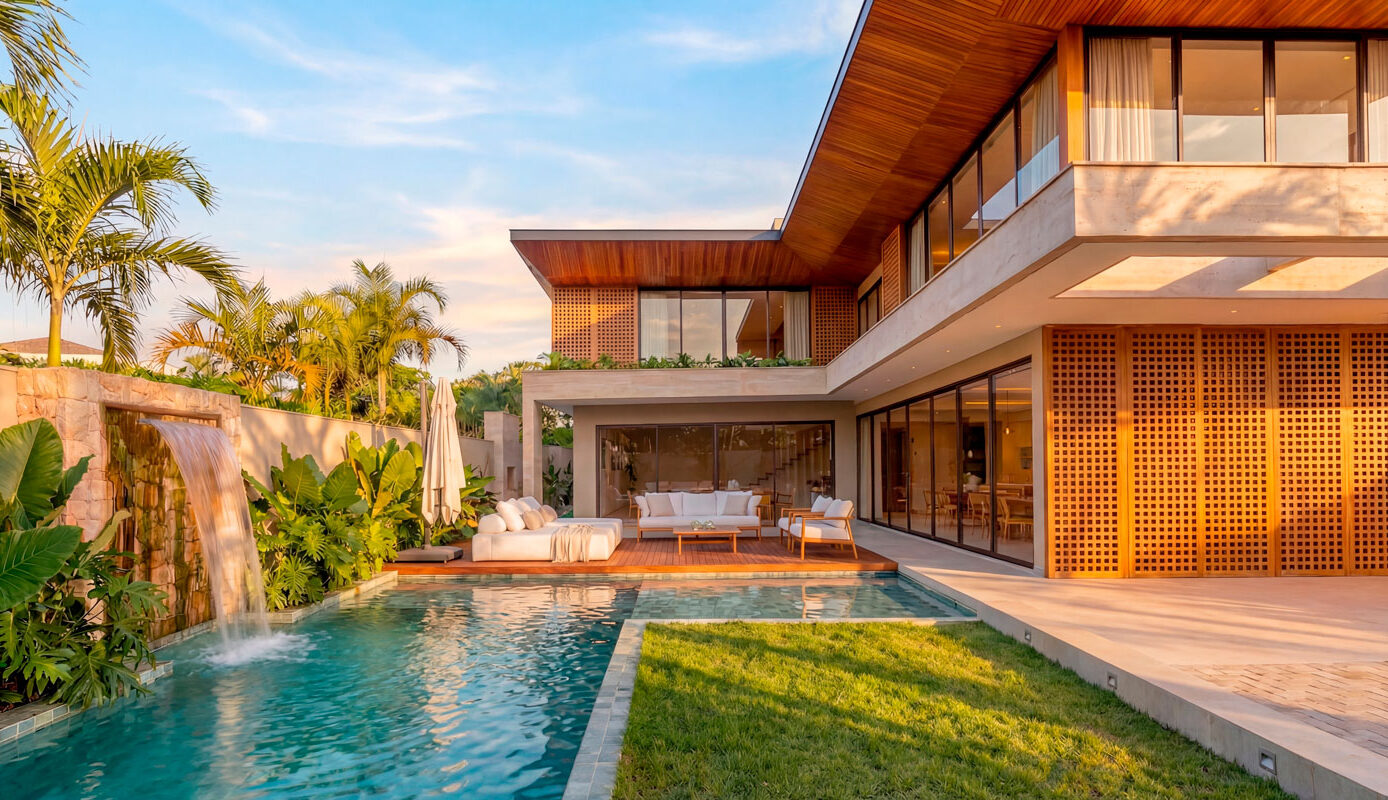
When we talk about high-end homes in the tropics, the conversation usually starts with materials. Most of my international clients come to me looking for that authentic “Organic Luxury”: real wood, raw stone, and a seamless connection with the outdoors. But here’s the reality: the Bahian climate is as brutal as it is beautiful. Salt air and intense sun can destroy “premium” materials if they aren’t specified with deep local expertise.
Trust, for me, means being honest about what works and what doesn’t. I don’t just choose materials that look good in a render; I curate textures that age gracefully. In the video below, you can see this rigor in practice: we use Cumaru wood for the ceilings and slatted panels because it is one of the most resilient species for the Brazilian coast. Combined with hand-applied “fudge” textures, it creates a sophisticated, grounded atmosphere. My job is to ensure these natural elements are integrated with a technical backbone, so your home ages like a fine wine, not a liability.
Transparency Through Data: Our Management Framework
The real question isn’t how your home starts, but how it finishes. Managing a high-stakes project in Bahia from another country requires more than trust; it requires a data-driven system. We bridge the distance gap using a digital framework that keeps you in the loop without the need for constant travel.
Through bi-weekly technical reports, precise budget tracking, and real-time photo/video updates, you see the actual progress of the wood joinery and the finishing stages as they happen. My office serves as your eyes and ears on the ground, ensuring that the level of rigor you see in these videos is exactly what gets delivered to your site. This is transparency at the highest level—architecture backed by management technology.
Building in Bahia should be an investment in your lifestyle, not a source of constant stress. If you own a plot of land and are looking for a partner to turn your vision into a high-end reality with absolute technical safety, let’s see if we are a match. I invite you to follow my daily work on Instagram, where I document the decision-making process and the technical rigor of our active sites in real-time.
How Much Does it Cost to Build a High-End Home in Bahia?
This is the most frequent question I receive from international investors. The honest answer is: it depends less on the size and more on the specifications. For high-end projects in the Southern Coast of Bahia, our latest benchmarks show construction costs ranging between R$ 4,000 and R$ 6,000 per square meter.
This range covers everything from 300m² boutique residences in Itacaré to mansions exceeding 800m² in Ilhéus or Una. While larger homes may benefit from economies of scale in certain areas, the overall cost is driven by the complexity of execution, the quality of specified materials, and the level of technical control required.
One thing is certain: poorly managed projects in the tropics always cost more. Without rigorous technical supervision, the costs of rework and the replacement of materials unsuitable for the coastal climate can turn any initial budget into a financial drain. Investing in technical management is not an extra cost—it is the only way to keep the final investment aligned with the initial plan.
What is the average timeline for construction?
For medium to high-end projects, the execution timeframe usually ranges from 14 to 24 months, depending on the complexity and the existing infrastructure of the plot. Remote coastal areas require more meticulous logistical planning, which directly influences the schedule. We prioritize a realistic timeline that respects the drying times of noble materials and the precision of high-end finishing.
How do we start a project?
The first step is a Technical Feasibility Analysis. We evaluate your land, your requirements, and the estimated investment to determine if there is a solid foundation to move forward. If you are looking for a high-level partnership to execute your vision in Brazil, let’s talk.

